Ladies of Purple: Byzantine Women in the Imperial Court
by Dane A. Clement
[sketchfab id=”d6074f826e62476c8f8f7c2a1a3b5a02″]
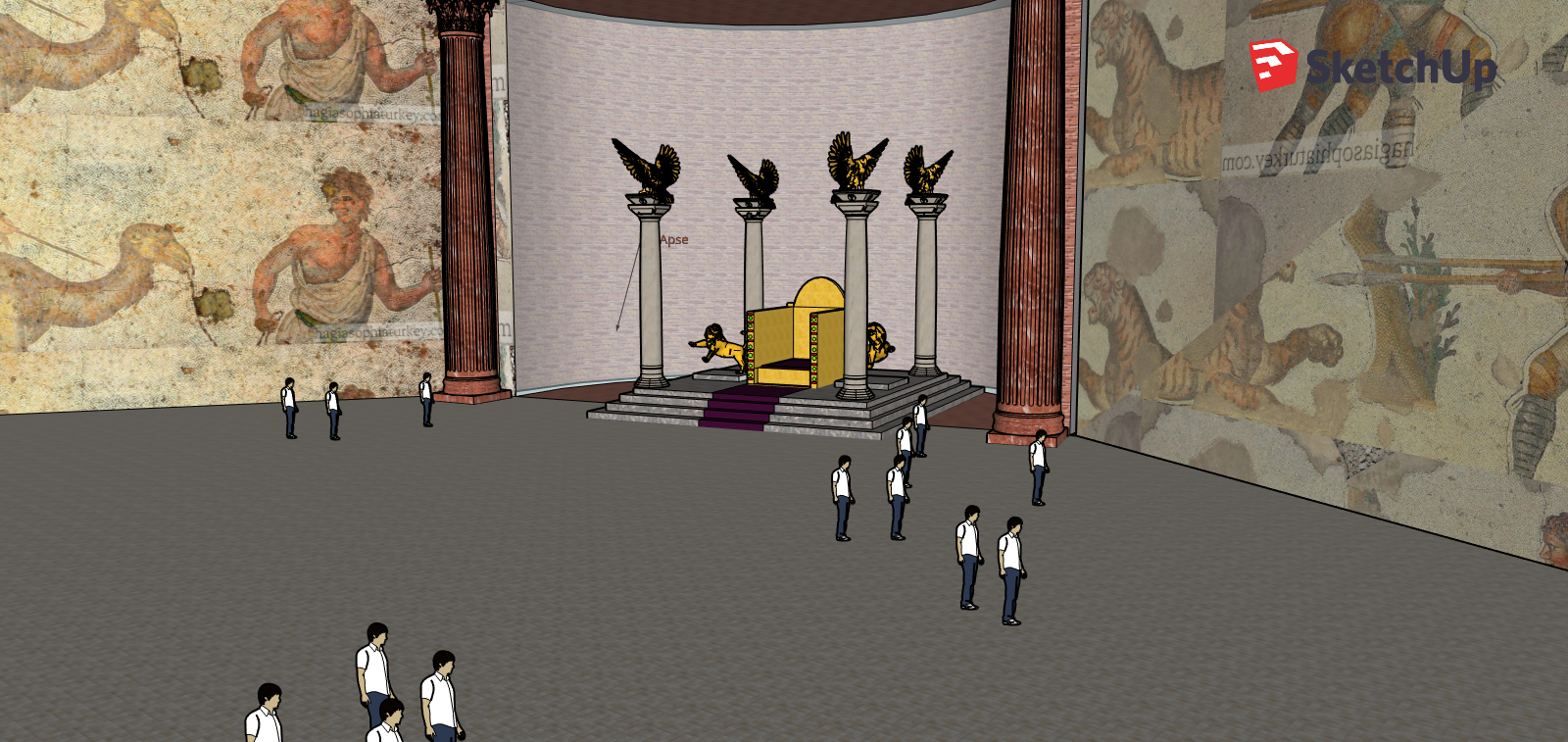
Despite the permanent split of the Roman Empire into Western and Eastern empires by Emperor Theodosius I (r. 379-395 CE) in the 4th century CE, the Eastern Roman Empire, now commonly referred to as the Byzantine Empire, managed to continue to thrive and manage a vast, mutli-ethnic, empire spanning from the shores of the great Danube river to the sands of Egypt and Arabia. To truly understand how the Byzantines were able to rule this area for 977 years, requires an examination of how they utilized imperial spaces.The purpose of this project was to examine the lives and roles of the women who occupied this space and how they were able to make the climb to grasp and hold on the tendrils of power. Byzantine society maintained a great part of its traditional Roman culture and social views regarding the role of women. Women were still held socially accountable for achieving high status marriages, fulfilling the roles of motherhood and administering the households of their husbands. The Book of Ceremonies or De Cremoniis, commissioned by the Emperor Constantine VII (r.913-959CE ), provides copious detail regarding courtly rituals from the time of Justinian the Great (r. 527-565CE) which were integral in Byzantine court culture. This was valuable for both viewing the roles which women of the imperial household would have been placed in the throne room, the literal epicenter of imperial power. To assist in the visualization of this room and the roles which these ladies of the imperial court would have filled, my research partner, Madi Pehringer, and I have created a 3D model interpretation of the Chrysotriklinos, one of the lavish throne rooms of the Great Palace complex located in Constantinople.
In order to begin our 3D visual construction of the Chrysotriklinos throne room, Madi and I began to make in depth analysis of primary sources regarding the throne room. Our main research focus was devoted to these primary sources in order to gain a first hand glimpse of what the imperial throne and the room in which it was housed looked like. We tended to stay away from secondary sources unless absolutely necessary due to the possibility of swaying our original interpretation in favor of the interpretations formulated by other scholars. For this reason, De Ceremoniis became our primary source to draw on for our model. Commissioned by the Emperor Constatine VII (r.913-959CE ), De Ceremoniis was designed as a manual for all forms of ceremony and protocol at the imperial court. What helped Madi and I choose this document is that many of the situations it describes within its pages occurs within the Chrysotriklinos. This provided us with volumes of in-depth details about the construction and layout of the throne room, and its visual aspects such as its lavish decoration. However, the source is around 800 pages, coupled with the unprecedented shutdown of the university and implementation of social distancing via executive order, made each chapter virtually impossible. To combat this situation, Madi and I used a distance reading technique to analyze De Ceremoniis. We sat down and selected key words and/or phrases that would be relevant to our specific topic, including, ‘throne’, ‘palace’, ‘emperor’ and ‘Constantinople’ in order to highlight sections which might be of future research interest. From these highlighted sections, individual selections were taken which contained information that was pertinent to the physical dimensions of the throne room.

The details provided by the pages of De Ceremoniis provided a firm foundation and scaffolding upon which our model would now be constructed. Unfortunately, we were not able to find exact figures regarding the scale of the room, or materials used in its construction. In order to determine the scale of the throne room, we decided on a diameter of one hundred feet, given that a decent number of people would have to be comfortably held in the throne room at any given time due to its importance in governing the vast and diverse empire. The source itself also lacked detailed descriptions of the types of decoration, particularly in regard to wall and floor mosaics. We wanted to see if we could find descriptions, but we balanced this by taking into account archaeological records from the other rooms in the palace or from other monumental buildings in Constantinople.
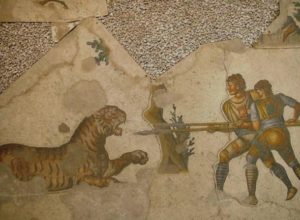
An account from the famous medieval Muslim traveler, Ibn Battuta (1304-1369), a man who had traveled a great portion of the Mediterranean world, including the great cities of Northern Africa and the Levant, provided details from an outside perspective about the Great Palace and his meeting with the Emperor Andronicus III (r. 1328-1341) in the 14th century. Within his recollection of his meeting with Andronicus, Battuta was able to confirm our general estimation of the scale of the throne room by his choice of descriptors, among which were “great” and “large”[1]. While these are by no means numerical confirmations, their use does indicate a room of a certain size. Buttuta also provided detail about the types of mosaics that served as decoration around the throne. Battuta records that on these mosaics there were “pictures of creatures, both animate and inanimate.”[2] Armed with this primary account of the wall mosaics in the throne room, Madi and I decided that mosaics as wall decoration would be entirely appropriate within our model. To find mosaics fit for the center of imperial attention, we looked at the mosaics of the Great Palace courtyard that were discovered during excavations ranging between 1935-1954 and now housed in the Great Palace Mosaic Museum[3]. Despite the fact that they are floor mosaics, they are similar to the styles that would have most likely been found on the walls of the throne room.
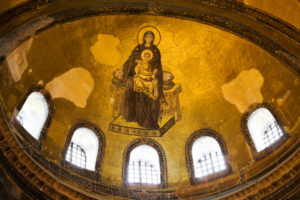
Other Byzantine monuments also allow us to formulate what the interior of the Chrysotriklinos would have looked like. Once such a building is Justinian’s famous Church of Holy Wisdom, known by its proper Greek name, Hagia Sophia. One of the most important and prevalent aesthetics of Byzantine architecture was that of light. The Byzantines were masters at manipulating light into their structures. To enhance the effect of light within the Hagia Sophia, many of the large mosaics within the church had their tesserae (the small pieces that form a mosaic) painted gold in order to show both a sort of depth and dynamism to figures within the mosaics, and to add to the appearance of the divine figures that these mosaics often contained. Several types of marble were often used in the construction of floors of the Hagia Sophia. Marble has a peculiar resemblance to the waves and ripples of water when light hits its surface [4]. This phenomenon of movement while in a stable environment, both from the mosaics and the marble floors of the Hagia Sophia convinced Madi and I that the floor of the throne room included this marble and its walls plastered with mosaics, placed in well lit areas in order to really make them come to life.
Up until this point in this paper, I have discussed the methods of Madi and I and how we have created our interpretation of the Chrysklinos palace, but I will now begin discussing the role of women in the Byzantine imperial court and how these matrons of empire interacted with a space such as the imperial throne room. The women who ruled the vast and diverse Byzantine dominion played a major rule in the governance of their empire, sometimes ascending to the very top of the imperial hierarchy, despite living within patriarchal society, achieving far more than their western royal counterparts. Byzantine empresses were literal and tangible sources of power within the imperial state, while balancing their traditional roles as a women[5]. The methodology which I employed to help solve this question differs from our model due to the greater reliance upon secondary sources to help create and solidify my understanding of how women would have interacted with Byzantine imperial court culture. However, to truly understand how these women of the imperial family would have utilized this space, it is important to see the avenues by which they arrived into the throne room.
The road to the imperial throne was largely closed except to women who came from the ranks of the empire’s aristocratic nobility. Young noble girls were often recruited to be displayed in the imperial bride show, a ceremony which Byzantine historian Judith Herrin places on par with a modern “beauty contest”[6]. The bride show saw the imperial prince choose the most attractive contestant to marry and some day carry the most important role a woman could occupy in the imperial hierarchy. In addition, sisters of the successful bridal candidates were often able to find themselves appointed as the empress’s ladies-in-waiting, where they often found themselves courted by the emperor’s brothers/relatives, and other high ranking imperial officials[7]. However, despite the usual monopoly of noble families on the imperial bride show, several empresses such as Irene of Athens (r. 797-802 CE), the first woman to rule the empire without a male consort, and others came from minor provincial families [8].
Another way for women to achieve high position within the court was to deal in the practice of political marriages as a way to form and strengthen alliances between the imperial house and several of the more powerful noble families of the empire. Even foreign princesses found themselves in Constantinople, betrothed to become the next empress. Manuel I Komnenos (r. 1143-1180 CE) had his son, the future emperor Alexios II (r. 1180-1183 CE) marry Agnes (Anna) Capet, daughter of the French king Louis VII in his drive to secure matches with the great powers of Western Europe[9]. Manuel himself had married the German-born Bertha (Irene) of Sulzbach, adopted daughter of Holy Roman Emperor Conrad III, until her death in 1159. He then married Marie of Antioch[10], mother of Alexios II. While the imperial bride shows and imperial marriages did not take place within the throne room in front of the enthroned emperor or empress, these ceremonies were key in determining which women could find themselves placed in and or on the imperial throne. However, some women to populate the throne room would have already been at court. In addition to marriage alliances, women were also able to advance in their court standing based on the success of their husbands or through their own occupation of high court positions which was extremely important to maintain position. The emperor, being at the very pinnacle of secular authority, often assigned members of his own family very high household honors. One of these, the zostra patrikia, or Patrician of the Belt, was usually reserved for the emperor’s mother-in-law[11] and she would have been one of the women present in the empress’s reception of foreign delegations in the throne room.
In order to get a better understanding of how the empresses of the Byzantine Empire often held their own court within the imperial throne room, I chose to examine the reception for Princess Olga (r. 945-960) of the Rus and her ladies by Empress Helena (d. 989 CE) in 946 CE. De Cremoniis describes how the Empress Helena sat on the throne and that her daughter-in-law was seated in a golden chair next to her. Princess Olga and her retinue were led in by the imperial eunuchs, or praipositos and the doormen, ostiarioi[12]. The princess was obliged to answer questions put to her by the praipositos on behalf of the empress. When the empress had finished her private reception of the Rus princess, she stood up from the throne, went through the Lausiakos Hall and the Tripeton and went into the Kainourgios Hall and through it to her bedchamber[13]. Later, Olga was brought back to the throne room to have her audience with Emperor Constantine VII (r. 913-959), who was seated with the empress and his children. The princess was summoned from the Kainourgios Hall and she spoke as long as she wished to the emperor[14]. After greeting Olga, Helena then organized for a state banquet to be held, where she and her daughter in law once again sat on the throne and the Princess Olga seated besides them[15]. This episode demonstrates how important the empress was to Byzantine society and foreign policy, being given the opportunity and power to host a private reception with another female head of state.
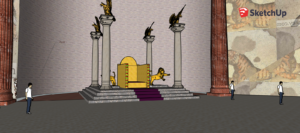
Although not equal to their male counterparts in the public eye, Byzantine women who achieved a high status and took a place within the coveted halls of the imperial throne room served as a crucial cog within the administration and social atmosphere of the Byzantine Empire, advising their husbands, and semi-frequently ruling in their own right from the throne room of the Chrysotriklinos. By endeavoring to understand the spaces in which these matrons of empire operated during the Byzantine’s 977 year life span, we begin to truly understand the women of the imperial court who, although living within the confines of a male dominated society, made their individual roles and achievements standout through the annals of history.
[1] Ibn Battuta. “Ibn Battuta: Travels in Asia and Africa 1325-1354.” Medieval Internet Sourcebook. Accessed March 2020.
[2]Ibid
[3] Great Palace Mosaic Museum
[4] Barry, Walking on Water, 627
[5] Lee, Gendered Souls, 9
[6] Herrin, Imperial Court, 173
[7]Ibid
[8]Ibid
[9] Hilsdale, Constructing a Byzantine Augusta, 460
[10]Ibid
[11] Herrin, Imperial Court, 173
[12]Constantine Porphyrogennetos, The Book of Ceremonies, 595
[13] Ibid
[14] Ibid
[15] Ibid
Sources
Barry, Fabio. “Walking on Water: Cosmic Floors in Antiquity and the Middle Ages.” The Art Bulletin 89, no. 4 (2007): 627-56. Accessed April 29, 2020. www.jstor.org/stable/25067354.
Battuta, Ibn. “Medieval Sourcebook: Ibn Battuta, Travels in Asia and Africa 1325-1354, Tr. and Ed. H. A. R. Gibb (London: Broadway House, 1929), sourcebooks.fordham.edu/source/1354-ibnbattuta.asp.
Garland, Lynda. “”The Eye Of The Beholder” : Byzantine Women and Their Public Image From Zoe Porphyrogenita to Euphrosyne Kamaterissa Doukaina (1028-1203).” Byzantion 64, no. 1 (1994): 19-39. Accessed April 26, 2020. www.jstor.org/stable/44172129.
Hagia Sophia Research Team. “Great Palace Mosaic Museum.” Great Palace Mosaic Museum , 13 Sept. 2018, hagiasophiaturkey.com/great-palace-mosaic-museum/.
Herrin, Judith. “Byzantium: Surprising Life of A Medieval Empire” Princeton University Press 2007: pp 170-184
Hilsdale, Cecily J. “Constructing a Byzantine “Augusta:” A Greek Book for a French Bride.” The Art Bulletin 87, no. 3 (2005): 458-83. Accessed April 27, 2020. www.jstor.org/stable/25067191.
Lee, Jessica R., “Gendered Souls: Female Religious and Imperial Power in Early Byzantium” (2014). Scripps Senior Theses. Paper 510. http://scholarship.claremont.edu/scripps_theses/510
Maguire, Henry. “Byzantine Court Culture from 829 to 1204.” Dumbarton Oaks, 2004, books.google.com/books/about/Byzantine_Court_Culture_from_829_to_1204.html?id=qjy2d8ExpTAC.
Porphyrogennetos, Constantine. “The Book of Ceremonies”, trans. Ann Moffatt and Maxeme Tall (with the Greek Edition of the Corpus Scriptorum Historiae Byzantinae [Bonn, 1829]), Byzantina Australiensia, 18,1 (Canberra: Australian Association for Byzantine Studies, 2012). 595-597
Psellus, Michael. “Michael Psellus: Chronographia.” Internet History Sourcebooks, 1999, sourcebooks.fordham.edu/basis/psellus-chrono07.asp.
“Great Palace Mosaic Museum.” Hagia Sophia, 13 Sept. 2018, hagiasophiaturkey.com/great-palace-mosaic-museum/.